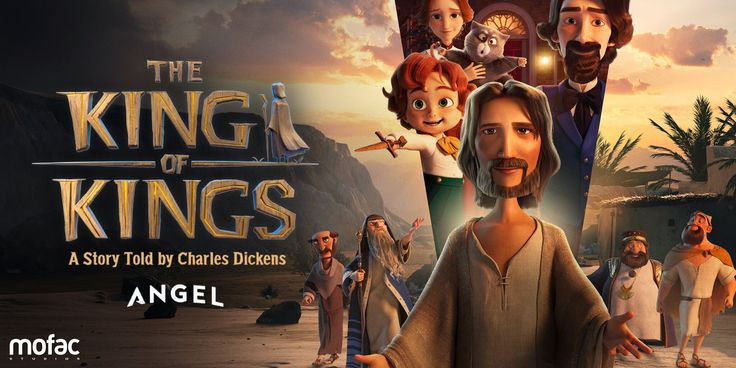
The recently released children’s animation, The King of Kings (2025) tells the story of Jesus
through the voice of Charles Dickens. If you’ve seen the film with its impressive cast (Kenneth
Branagh, Oscar Isaac, Uma Thurman, Pierce Brosnan) you may have thoughts or questions
about the Bible.
We’ve put together 4 good reasons you might want to engage with the Bible, beginning with
the most obvious question of all – what actually is the Bible?
WHAT IS THE BIBLE?
As a world bestseller, the Bible is one of the most famous books on the planet. At times forbidden
or burned throughout history, it clearly holds resonance across time and culture. There are many
ways to describe it – as a library, sacred literature, God’s Word, an anthology, eternal wisdom etc.
The question is, can a body of ancient literature compiled over time with different genres,
have anything life-giving to say in the 21st century? We believe it does, and inspired by the
story told by Charles Dickens in the King of Kings, we will consider 4 good reasons to read
Scripture and ways to connect with the Bible text.
WHY READ IT?
Learn from a repository of ancient wisdom. Dip into the words of Proverbs, or the lament of the
Psalms. Prophesy with Deborah and weep with Naomi. Sing with Miriam, gather smooth stones
with David, hope with Ezekiel. Wrestle with Job and dream with Joseph. Grab hold of the fringes of
Jesus’ garment. Gather your alabaster jar with fragrant oil and pour it on the feet of Salvation like
the unnamed woman in Luke 7. Think about the longevity and incredible art of scribal culture
through which biblical texts were transmitted. Think about the voices within the texts and the
unnamed people men and women who often have pivotal roles in different stories.
Engage with an ancient library. As mentioned by Simon Brummer, (Biblical Studies PhD student
and contributor for Bible Society Ireland) the Bible is not a singular book – it is a library. Its
66/73 books were composed over the course of many centuries by a variety of authors with
different backgrounds, personalities, and purposes (although this diversity is within the matrix of
the Jewish world as it developed over time). Each book therefore explores who God is from a
slightly different point of view. As readers of Scripture, we discover new truths about God at
every turn. Some of these discoveries will resonate with us more than others, and some will
strike us more profoundly at various times during our lives.
Get to know yourself. The more time we spend with the Bible, the more we will discover
ourselves within its pages. We may recognise ourselves and others as made in God’s image, and
we may experience the undulating emotions of the Psalms; we may see our own impatience in the
different actors in different texts, and we may pause to ask ourselves – do I have the courage of
Esther? Is my heart ‘upside-down’ like Pharaoh (Ex 14:5)? Will I stand by while Christ is
crucified or deny Him to a Roman soldier, and will I run to the garden to find Him risen? We must
not make the mistake of thinking that the Bible is simply a book about God – it is a library of books
about God and about what it means to be human, and for God to be ‘with us’ in every sense as we
walk towards wholeness.
Be challenged. Consider the questions the Biblical text asks us. Where are you (Gen 3:15)? What
are you seeking (Gen 37)? What is in your hand (Ex 4)? In that, consider the idea of getting to
know yourself as we mentioned earlier. . This is something we hear a lot about – the true you. It has
been suggested (St Gregory the Great) that Scripture can be like a mirror, we read it but it also
reads us and what is buried under the surface has space to emerge into the light of day. Exploring
the text with this is in mind can be helpful, as this is a human text with human stories that are wildly
relational. As we are challenged by the Bible and we get to know ourselves and the text more
deeply, so we also find comfort and get to know God through its words.
If you want to learn more or cultivate a deeper engagement with the Bible, please visit
www.biblesocietyireland.ie, or email info@nbsi.ie if you want to find out more about The
Bible Course, the New Edition (an 8-session deep dive into the Bible, developed by BFBS).